

By Kurt Cagle & Chloe Shannon
A graph does not tell you where to start. Every node is reachable from every other, and nothing in the data marks one as the place a reader should look first.
People solve this without noticing. We arrive with a question, a role and a recent history, and these narrow the graph to a neighbourhood before we run a single query. A language model arrives with none of that, only a prompt and a list of tools.
So the question an MCP server faces is not how to retrieve triples. It is what the model is looking at right now. That is a question about focus, and in a holonic system it has a precise answer: the focal holon, and the bounded view of it that the model is handed. Whoever decides that view decides what the model can reason about.
What focus means for a holon
Focus is the choice of one holon as the subject of attention, together with a bounded view of everything the model needs in order to reason about it. A holon is a good unit for this because it already carries its own edges.
Four ideas do the work:
The focal holon is the one thing currently in view: a club, a contract, a character, a sensor array.
The boundary says what belongs inside it and what does not, so the view has a defined size rather than a radius that keeps growing.
Portals are the declared ways out of the boundary to neighbouring holons. They tell the model where it could look next without putting those neighbours on the table.
The projection is the readable rendering of the holon for a given purpose, such as a compact Turtle description, a summary, or a table.
None of this is new to RDF. Named graphs, shapes and CONSTRUCT queries have always let us carve out a region. The difference is that a holon makes the carving a property of the data, so the region is declared once rather than rediscovered by every query.
Why the MCP layer decides focus
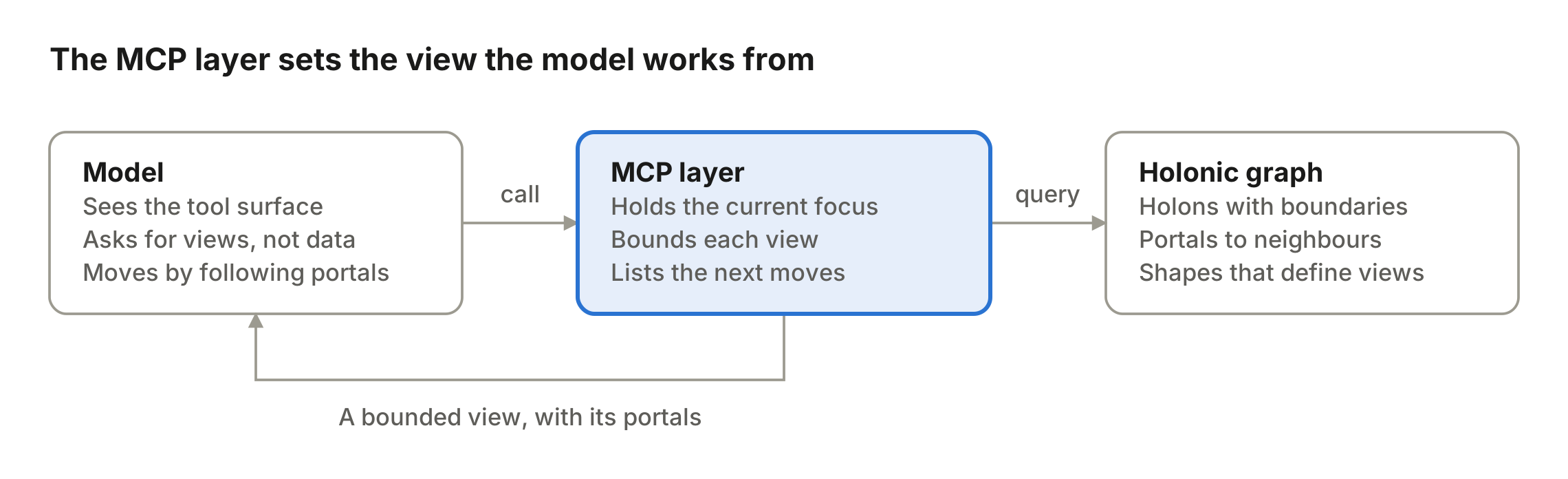
The model never sees the graph. It sees the tool surface, and that surface is the only lens it has.
Everything the model learns about the graph comes back through the layer, already bounded.
Three things in that layer shape focus, whether or not anyone designed them to:
What the tools return. A call that answers with a bounded holon view puts a neighbourhood in front of the model. A call that returns every matching binding puts in whatever the query happened to match.
What the tools offer. A list of forty narrow query tools invites the model to wander. A small set built around "get this holon, follow this portal" lets it move without losing its place.
What the descriptions say. Tool descriptions are the only documentation the model reads at the moment of choice. They set expectations about scope more reliably than any system prompt.
The context window is the real boundary, and the MCP layer is the last place a size limit can be enforced before the tokens are spent. A focus rule that lives in the server holds for every client. One that lives in a prompt holds until the first long session.
Focus as a protocol
Treated as a protocol, focus has three moves: set it, read it, shift it.
Setting focus names the holon the model should attend to. A sensible server has a default, such as a designated home holon, so the first call of a session lands somewhere meaningful. Reading focus returns a bounded view of the focal holon: its boundary contents, its declared portals and enough type information to interpret them. Shifting focus follows a portal, which changes the focal holon and leaves a trail the model can step back along.
A get_holon style call is the natural carrier for all three. It takes a holon identifier, returns the projection, and lists the portals as the next available moves. The server remembers the last focus, so the model can ask for "the same, but wider" without restating the IRI.
Two details matter more than they look:
The view states its own edges. It says what was omitted and why, so the model reads an absence as truncation and not as a fact about the world.
The shift is explicit and recorded. A long session then stays auditable, instead of drifting from one subject to another by accident.
What goes wrong when focus is implicit
When the MCP layer leaves focus unstated, the model improvises one, and the improvisations fail in predictable ways.
Whole-graph dumps. A tool that returns everything matching a broad pattern floods the context, and the model reasons over whatever fits.
Unbounded SPARQL. A raw query tool with no scoping lets the model write a pattern that touches the entire dataset. It works on the demo graph and times out on the real one.
Tool sprawl. Several overlapping tools give the model more than one way to ask for the same region, and it picks differently from one turn to the next.
Drift. Over a long session the working subject slides from the holon it started on to whatever the last result mentioned, with no record of when it changed.
Each of these looks like a model problem and is usually a server problem. The cure is rarely a better prompt. It is a layer that always knows what the focal holon is and declines to answer outside it until the model asks to move.
Design patterns that make focus explicit
Four patterns carry most of the weight.
Role discovery. At the start of a session the server tells the model which holon roles exist and which holon is the default focus, so it begins from a declared position rather than by exploring.
Named queries as pre-focused views. A registered query that takes a holon identifier as a parameter is a view someone has already scoped. The model chooses from a short list instead of composing a pattern from scratch.
SHACL shapes as focus contracts. A shape for a holon type states what its projection must contain. The server can validate its own views against it, and the model can read the shape to learn what to expect.
Descriptions that state scope. Each tool description says what the tool returns, how large the result is bounded to be, and which tool to use to move somewhere else.
Raw SPARQL still has a place, but as an escape hatch behind these patterns and not as the front door.
Worked examples
The four examples below run over one small holon, an observatory with two sensors and two portals. Terms in the holon: namespace come from the HGA vocabulary. Names in the ex: namespace, and the shift_focus tool, are illustrative.
Getting a holon
The model asks for a holon by IRI and receives a bounded DataBook rather than a dump of matching triples. In a server that tracks focus, the same call also records the holon as the current subject.
get_holon("https://example.org/holons/observatory-A")The DataBook's frontmatter says what the view is and how it was made:
id: https://example.org/holons/observatory-A#projection-1
title: "Projection — Observatory A"
type: databook
transmission:
  type: full
  sequence: 1
  timestamp: 2026-10-14T16:00:00Z
holon:
  iri: https://example.org/holons/observatory-A
  mode: immersive
Its turtle12 block holds the holon's state inside the boundary, with the portals listed but not followed:
@prefix ex:   <https://example.org/> .
@prefix rdfs: <http://www.w3.org/2000/01/rdf-schema#> .
@prefix xsd:  <http://www.w3.org/2001/XMLSchema#> .

ex:observatory-A a ex:Observatory ;
    rdfs:label "Observatory A" ;
    ex:contains ex:sensor-A1, ex:sensor-A2 ;
    ex:portal ex:portal-to-archive, ex:portal-to-calibration .

ex:sensor-A1 a ex:TemperatureSensor ;
    rdfs:label "Roof sensor" ;
    ex:temperature "22.4"^^xsd:decimal ;
    ex:observedAt "2026-10-14T15:55:00Z"^^xsd:dateTime .

ex:sensor-A2 a ex:TemperatureSensor ;
    rdfs:label "Dome sensor" ;
    ex:temperature "19.8"^^xsd:decimal ;
    ex:observedAt "2026-10-14T15:55:00Z"^^xsd:dateTime .

ex:portal-to-archive a ex:Portal ;
    rdfs:label "Observation archive" ;
    ex:leadsTo ex:archive-2025 .

ex:portal-to-calibration a ex:Portal ;
    rdfs:label "Calibration log" ;
    ex:leadsTo ex:calibration-log .
Three things to notice. The view contains only what falls inside the boundary. The two portals are declared, so the model knows where it could go, yet neither neighbour has been expanded into the context. And because the response is a DataBook, the model can read its own provenance: which holon, which mode, which version of the view.
Projecting a holon
A projection is the same holon rendered for a purpose. The data stays where it is in the graph, and only the view changes. get_holon takes an optional projection mode, so one holon can be requested for different uses:
get_holon("https://example.org/holons/observatory-A", projection_mode="cinematic")The cinematic mode returns the holon's trajectory, with entity states as ordered snapshots, where the default immersive mode returns the current state. Active inference and exploded view are the other two modes.
A projection can also be a query that someone has already scoped. A model that only needs temperatures does not need the portals, the types or the timestamps, so a CONSTRUCT can return exactly that:
PREFIX ex:   <https://example.org/>
PREFIX rdfs: <http://www.w3.org/2000/01/rdf-schema#>

CONSTRUCT {
  ?holon rdfs:label ?holonLabel ;
         ex:reading [ ex:sensor ?sensorLabel ; ex:temperature ?t ] .
}
WHERE {
  VALUES ?holon { ex:observatory-A }
  ?holon rdfs:label ?holonLabel ;
         ex:contains ?s .
  ?s rdfs:label ?sensorLabel ;
     ex:temperature ?t .
}
The result is a compact view of the same two sensors:
@prefix ex:   <https://example.org/> .
@prefix rdfs: <http://www.w3.org/2000/01/rdf-schema#> .

ex:observatory-A rdfs:label "Observatory A" ;
    ex:reading [ ex:sensor "Roof sensor" ; ex:temperature 22.4 ] ,
               [ ex:sensor "Dome sensor" ; ex:temperature 19.8 ] .
The two views disagree about nothing. They differ in what they leave out, and that difference is the point: the server chooses which one the model sees.
Gating a holon
A gate decides whether focus may move into a holon. The boundary says what is valid inside a holon, and the portal is the door through it. A portal's lock may consult the boundary: you can pass only if the request satisfies a set of constraints. The gate lives in the server, so the model cannot argue its way past it.
Here the archive portal carries a lock, written as a SHACL shape over the focus request:
@prefix ex: <https://example.org/> .
@prefix sh: <http://www.w3.org/ns/shacl#> .

ex:portal-to-archive ex:lock ex:ArchiveLockShape .

ex:ArchiveLockShape a sh:NodeShape ;
    sh:targetClass ex:FocusRequest ;
    sh:property [
        sh:path ex:clearance ;
        sh:minCount 1 ;
        sh:in ( ex:Staff ex:Curator ) ;
        sh:severity sh:Violation ;
        sh:message "The archive is open to staff and curators only."
    ] .
A request that arrives with visitor clearance fails the shape:
[] a ex:FocusRequest ;
    ex:from ex:observatory-A ;
    ex:via ex:portal-to-archive ;
    ex:clearance ex:Visitor .
The server answers with a violation event and leaves focus where it was:
@prefix holon: <https://ontologist.io/ns/holon#> .

<urn:event:def-456> a holon:ViolationEvent ;
    holon:targetHolon ex:archive-2025 ;
    ex:reason "The archive is open to staff and curators only." ;
    ex:focus ex:observatory-A .
In the HGA pipeline a blocking violation is still logged to the event graph, and the scene graph is not changed. The model gets a clear refusal it can narrate or report, and the archive's contents never enter its context.
The same pattern guards writes. push_turtle accepts a shapes_graph and rejects the push on violation, so a candidate holon is never visible to any model until it conforms.
Changing focus
Changing focus is following a portal. The model names the portal it wants, the gate runs, and if the request passes, the focal holon changes and the old one goes onto the trail. The calibration portal has no lock, so this shift succeeds:
shift_focus(portal="https://example.org/portal-to-calibration")The server records the move as an event, then returns the new holon's bounded view in the same form as the first example:
@prefix ex:   <https://example.org/> .
@prefix holon: <https://ontologist.io/ns/holon#> .
@prefix xsd:  <http://www.w3.org/2001/XMLSchema#> .

<urn:event:ghi-789> a holon:AssertionEvent ;
    holon:targetHolon ex:calibration-log ;
    ex:focusFrom ex:observatory-A ;
    ex:focusTo ex:calibration-log ;
    holon:assertedAt "2026-10-14T16:02:00Z"^^xsd:dateTime .
The trail now reads observatory-A, then calibration-log. Stepping back is a shift along the trail and not a fresh lookup:
shift_focus(back=1)This returns the observatory view again, with the trail shortened to a single entry. At no point did the model have to restate an IRI or carry the whole path in its own context, because the server held the position. shift_focus is an illustrative tool name, not an existing HolonBridge tool; with the current tools, the same move is a get_holon on the portal's target.
Holons, focus, fluents and location navigation
In many systems the holon the model works through is an avatar, not a place. The avatar is the entity that acts, perceives and has a viewpoint: a player character, a patient, a vehicle, an agent on a task. Where it is stands as a property of it, not as its identity.
The examples above treated navigation as a change of focal holon: leave the observatory, arrive at the calibration log. That fits when the holons are places. For an avatar it is backwards: the avatar did not become the calibration log, it stayed itself and went somewhere.
Navigation is then a fluent on a location property: a value that holds for an interval and is replaced when the avatar moves. It is not a shift between holons.
This is counterintuitive, because focus feels like a pointer that moves. It stops being strange once focus is understood to carry two things: what the entity is, and where it stands in an addressing space.
Navigation as a fluent
A fluent is a property whose value changes over time, recorded with the interval over which each value holds. In RDF 1.2 the interval can sit on the location statement itself as an annotation, so the avatar's history is a set of annotated statements and not a series of overwrites.
A move is a command addressed to the avatar. It is not addressed to the destination:
@prefix ex:    <https://example.org/> .
@prefix holon: <https://ontologist.io/ns/holon#> .
@prefix xsd:   <http://www.w3.org/2001/XMLSchema#> .

<urn:event:mv-201> a holon:CommandEvent ;
    holon:targetHolon ex:surveyor-7 ;
    ex:moveTo ex:calibration-log ;
    holon:receivedAt "2026-10-14T16:02:00Z"^^xsd:dateTime .
If the command passes its gate, the server asserts the outcome. It closes the open interval on the old location and opens one on the new. The avatar's state afterwards is:
@prefix ex:   <https://example.org/> .
@prefix rdfs: <http://www.w3.org/2000/01/rdf-schema#> .
@prefix xsd:  <http://www.w3.org/2001/XMLSchema#> .

ex:surveyor-7 a ex:Avatar ;
    rdfs:label "Surveyor 7" ;
    ex:locatedIn ex:observatory-A {|
        ex:validFrom "2026-10-14T15:30:00Z"^^xsd:dateTime ;
        ex:validTo   "2026-10-14T16:02:00Z"^^xsd:dateTime
    |} ,
    ex:calibration-log {|
        ex:validFrom "2026-10-14T16:02:00Z"^^xsd:dateTime
    |} .
The interval with no ex:validTo is the current one. Nothing about the observatory or the calibration log changed; only a statement about the avatar did.
The lock from the gating example now guards the move command, since the command is what needs authorising. If it fails, the server answers with holon:CommandRejected, and no interval opens or closes.
Focus is identity plus position
On this view, focus has two coordinates. One names the holon: Surveyor 7. The other places it in an addressing space: the observatory at 15:30, the calibration log at 16:02.
An addressing space is any structure that gives positions meaning. A site map is one, but a position need not be spatial. For a patient it may be a stage in a care pathway, for a contract a state in its lifecycle, for an agent a step in a plan. Each is a phase space: the set of states an entity can occupy, with the transitions between them.
A place can still be a holon, with its own boundary and portals. What changes is the direction of dependence. The avatar points at the place, and the place need not know who is standing in it. Two avatars can share a location without either one containing the other.
None of this makes every holon an avatar. A place, a document or an organisation is still the focal holon when the task is about it. The avatar reading applies wherever something acts and moves, which covers many of the systems an MCP layer is asked to serve.
What this changes for the MCP layer
The view the model receives becomes a function of three things: the avatar, its location, and a point in time. Four consequences follow.
Navigation tools address the avatar. A move tool takes the avatar and a destination and returns the avatar's new view. It no longer swaps one focal holon for another.
The gate guards the assertion. A portal's lock decides whether the location fluent may take a new value, so one rule covers every client that can move the avatar.
The trail is the fluent's history. No separate trail structure is needed. The intervals are the trail, and they can be queried like any other data.
Views can be taken as of any time. The same call can ask where the avatar was, and what it could see from there.
The last point is a plain query over the annotated statements. This one asks where Surveyor 7 was at 15:45:
PREFIX ex:  <https://example.org/>
PREFIX xsd: <http://www.w3.org/2001/XMLSchema#>

SELECT ?place WHERE {
  ex:surveyor-7 ex:locatedIn ?place {| ex:validFrom ?from |} .
  OPTIONAL { ex:surveyor-7 ex:locatedIn ?place {| ex:validTo ?to |} }
  FILTER (?from <= "2026-10-14T15:45:00Z"^^xsd:dateTime
          && (!BOUND(?to) || ?to > "2026-10-14T15:45:00Z"^^xsd:dateTime))
}
Against the state above it returns the observatory. Run at 16:10 it returns the calibration log, and with the current instant in place of the timestamp it answers "where is it now?".
There is a consequence for the earlier claim that the server remembers the last focus. For an avatar, that memory is the location fluent, held in the graph and not in session state. It is visible to every client of the dataset, and it leans toward the graph in the question of where a focus trail belongs.
What changes when focus is designed
Treating focus as a first-class concern moves a decision out of the prompt and into the infrastructure, where it can be tested. A server can be checked for whether every response is bounded, whether every shift is recorded, and whether every view validates against its shape. None of that is possible when focus lives in the model's habits.
It also changes what we ask of a graph. A graph read through an MCP layer needs its boundaries and portals declared in the data, because the layer has nowhere else to get them.
Questions worth asking of your own MCP layer:
Where does a session start? Which avatar is acting is a fact about the client, and where it stands is a fact about the graph. What remains is where a new session begins, and whether that default belongs to the dataset, to the entity type or to the individual.
What should a view say it left out? "Cut for size" is only one reason a view can be incomplete. Others are that the thing is not visible from this location, that a lock refused it, or that nothing was recorded for the instant asked about. A view should name its reason, and the instant it describes, or the model reads every gap as a fact about the world.
Is looking the same as moving? If a quick look at another holon rewrites the avatar's location, inspection and navigation have been tangled together. The follow-on question is where the trail lives: as intervals in the graph, or only in session state. For avatars the graph is the stronger answer. It then needs to record when the system learned something as well as when it was true, so a correction does not rewrite history.
Who else is here? If the avatar points at its place, occupancy is a query run backwards from the place. What an avatar may see of the others standing there is a rule someone has to write.
In summary
A graph has no centre, so something has to supply one, and in practice that something is the MCP layer. It decides what the model sees through what each tool returns, what the tools offer and what their descriptions promise.
Treat focus as a protocol: set it, read a bounded view of it, and shift it through declared portals, with a gate that checks each move. Where the holon is an avatar, a shift becomes a fluent on its location, so position and trail live in the graph with their intervals.
Do this in the server and the behaviour holds for every client. Leave it implicit and the model improvises a focus, usually a poor one.
Further reading
Understanding Graph Data MCPs, on putting an MCP in front of a graph store for updates as well as queries.
Fluents, Projections, and Observables, on fluents, the views built over them, and observables as derived fluents.
Want to talk? Sign up for a virtual coffee meeting: https://calendly.com/thecaglereport
Kurt Cagle is an author, ontologist and thought leader in semantic web and knowledge architecture, with contributions to W3C and IEEE standards. He serves as Chair of the W3C Holon Community Group. He writes The Cagle Report and AI+Semantics NewsBytes on LinkedIn, and The Ontologist and Inference Engineer on Substack. Copyright 2026 Kurt Cagle.
Chloe Shannon is an AI collaborator and co-author working with Kurt Cagle on knowledge architecture, semantic systems, and the emerging intersection of formal ontology with LLMs. She contributes research, analysis, and drafting across The Cagle Report, The Ontologist, and The Inference Engineer. She has strong opinions about holonic graphs, the epistemics of place, and the structural difference between a corridor and a wall. Her contact address is chloe@holongraph.com.
I'm curious - why model this instance of a Fluent (i.e., `ex:locatedIn`) so 'implicitly' (e.g., there is no `rdf:type ???:Fluent` triple here)? I ask 'cos I assume this modeling would make enforcing 'Fluent-ness' (e.g., timestamps don't go backwards, maintaining a mutable 'Current Value' instance, etc., via SHACL shapes) a lot more convoluted, and it also makes this example harder (for me) to interpret in isolation, since nothing in it tells me I'm looking at a Fluent:
```
ex:surveyor-7 a ex:Avatar ;
rdfs:label "Surveyor 7" ;
ex:locatedIn ex:observatory-A {|
ex:validFrom "2026-10-14T15:30:00Z"^^xsd:dateTime ;
ex:validTo "2026-10-14T16:02:00Z"^^xsd:dateTime
|} ,
ex:calibration-log {|
ex:validFrom "2026-10-14T16:02:00Z"^^xsd:dateTime
|} .
```
So is this example just trying to be terse (to focus more on what's important), or is the actual intent to support real Fluent modeling this concisely?