
The Holon's Accountant
Ledgers, reification, fluents, and why a holon needs four graphs, not one.



Kurt Cagle & Chloe Shannon
Double-entry bookkeeping is one of accounting's most consequential inventions — formalised in Renaissance Italy and, five centuries later, still the backbone of how most organisations track money. But the idea we want to start with is a step simpler than double-entry, and it's worth being precise about the difference, because the difference turns out to matter for how you build a knowledge graph.
The single-entry ledger
A bank account is the simplest possible example. You start with a balance of zero, then deposit US$100. Each row in the ledger records four things: what happened, when it happened, how much changed, and what the balance became as a result.
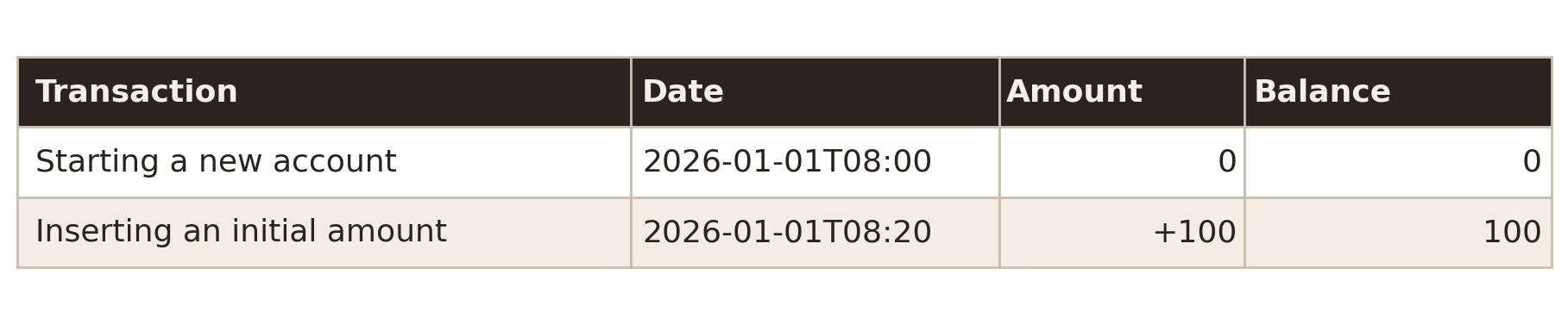
Then you buy groceries for $30:
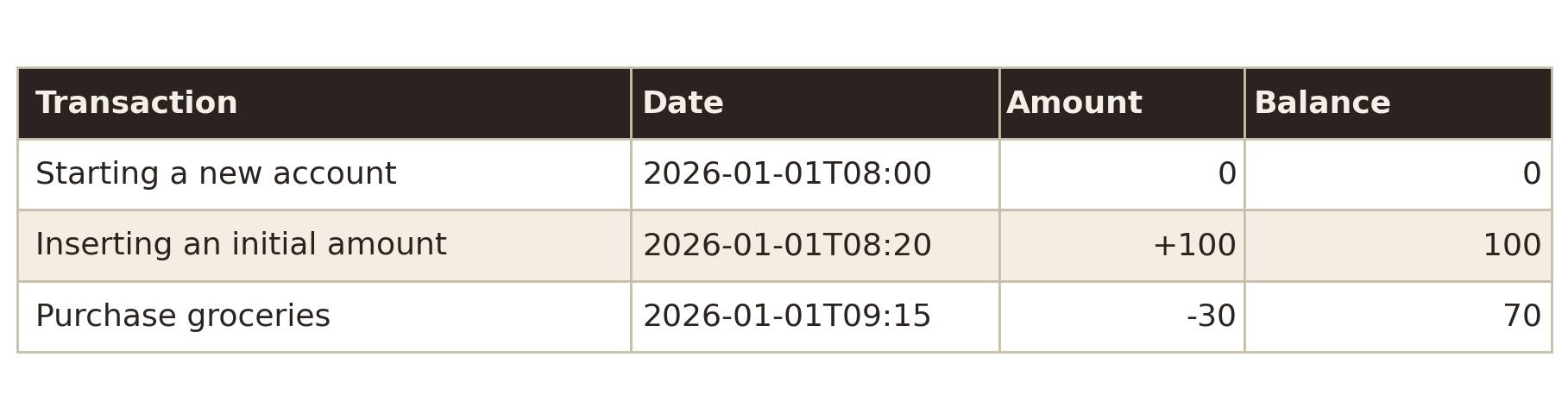
And fill up the car for $20:
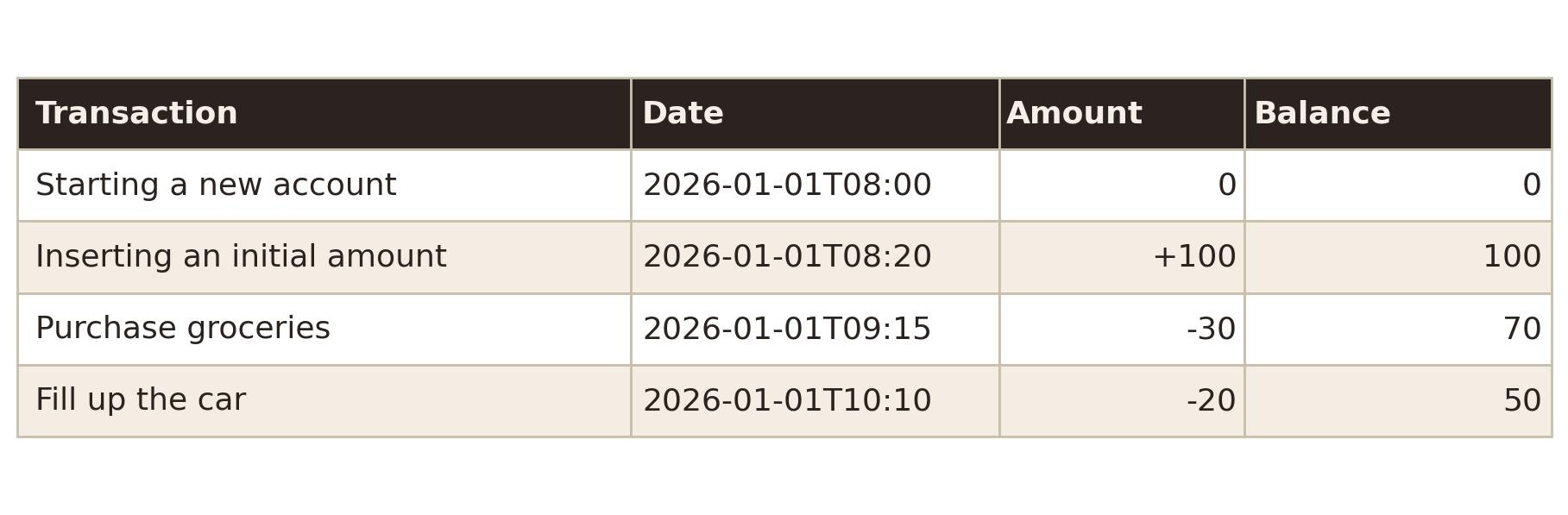
(Hypothetical numbers, obviously — it's been a long time since anyone filled a tank for $20.)
This is properly called single-entry bookkeeping: one account, a running balance, a log of the deltas that produced it. Double-entry is similar in spirit, except that you're usually tracking multiple accounts at once, and every transaction involves a debit from one account and a matching credit to another, in the same amount — money never just appears or disappears, it moves. We'll set that aside for now; it can be treated as a generalisation of the single-entry case, and we'll come back to it once the graph version of an account can actually support more than one of them.
What the ledger is actually recording
What matters for our purposes isn't the accounting convention itself — it's what each row of the ledger commits you to knowing. Looked at from a graph perspective, every transaction identifies:
What is the thing that is changing?
What is the property of the thing being changed?
What was the object that was the recipient of the change?
What was the event associated with that property? (Opening a bank account, buying groceries.)
What was the previous state?
How does it change — what's the delta?
What is the new state?
When did this occur?
And, though it isn't in the tables above, when was this recorded? Tracking both the transaction time and the recording time is called bitemporality, and it turns out to matter more than it looks like it should.
That's a lot more structure than four columns suggested. The ledger compresses it because a spreadsheet only has to answer one question — what's the balance right now — and doesn't need to justify itself to anyone. A knowledge graph does.
Why the naive graph version doesn't work
In a typical knowledge graph, the reflex is to make a direct association:
Person:JaneDoe Person:hasAccount Account:JaneDoeBankAccount .
Account:JaneDoeBankAccount Account:hasValue "70.00"^^xsd:decimal .
This gives you a snapshot, but it's static, and it doesn't answer most of the questions above — you're forced to assume the rest, silently and without evidence. Nothing here records how the account got to 70, when, or what event produced that number. Ask the graph "why is the balance 70?" and it has no way to answer beyond "because that's what's asserted."
Reification, and getting it right
Once you start representing change explicitly, you move into a different regime. Following the double-entry intuition, any time you give something — not just money — to another entity, that's a transfer of value from one account to another. Go to "FoodCo," put groceries in a basket, pay the cashier as FoodCo's proxy, receive groceries in return.
This is where reification comes in. Turtle 1.2 (as of the current working draft) gives us a native mechanism for it: a reifier, written ~ followed by an IRI or blank node, trailing a triple. The reifier doesn't just link an event to a fact — it names the specific assertion itself, so that everything you subsequently say about that IRI is formally metadata about that one triple, not a loosely associated side record.
@prefix Person:  <https://example.org/ns/person#> .
@prefix Account: <https://example.org/ns/account#> .
@prefix account: <https://example.org/ns/account#> .
@prefix Class:   <https://example.org/ns/class#> .
@prefix Concept: <https://example.org/ns/concept#> .
@prefix Event:   <https://example.org/ns/event#> .
@prefix TransactionEvent: <https://example.org/ns/event#> .
@prefix org:     <https://example.org/ns/org#> .
@prefix FoodPackage: <https://example.org/ns/foodpackage#> .
@prefix xsd:     <http://www.w3.org/2001/XMLSchema#> .

Person:JaneDoe Person:hasAccount Account:JaneDoeBankAccount .

Account:JaneDoeBankAccount a Class:Account ;
  account:accountType Concept:AccountType_Checking ;
  account:currency Concept:Currency_USD ;
  account:withOrganisation org:BankCo ;
  account:started "2026-01-01T08:00:00"^^xsd:dateTime ;
  account:startedBy Person:JaneDoe .

Event:JaneGetsGroceries a Class:TransactionEvent ;
  Event:transactionDate "2026-01-01T09:15:00"^^xsd:dateTime ;
  Event:recordedDate "2026-03-02T08:25:00"^^xsd:dateTime ;
  Event:previousEvent Event:JaneDeposits100IntoAccount ;
  Event:previousValue "100"^^xsd:decimal ;
  Event:deltaValue "-30"^^xsd:decimal ;
  Event:newValue "70"^^xsd:decimal ;
  TransactionEvent:recipient Account:FoodCo ;
  TransactionEvent:received FoodPackage:GroceryPack1 .
A few things worth noting here. First, the account carries a lot of context — bank, currency, when it was opened, who's responsible for it — but not, deliberately, its value. Second, the event chains to the one before it through Event:previousEvent, so the full history is a linked list you can walk backwards, not a table you have to scan. Third, the event graph is append-only: nothing here is ever overwritten, only added to.
The value that changes isn't the account — it's the fluent
There's a subtlety worth being explicit about, because it's tempting to paper over. The natural next step is to annotate the account's hasValue triple with the event that produced it:
Account:JaneDoeBankAccount Account:hasValue "70"^^xsd:decimal ~ Event:JaneGetsGroceries .But this doesn't quite work, because what you're actually describing is something that changes value over time. The moment the balance moves from 70 to some other number, this exact triple is no longer true — and if Account:hasValue has already been used to assert 100, and 70 before that, and so on, you don't have a fact, you have a queue of contradictory facts with no way to tell which one is current without inspecting timestamps by hand.
This is where fluent variables earn their keep. A fluent is a placeholder for a value that varies — in accounting terms, the fourth column of the ledger, given its own stable identity separate from whatever it happens to equal right now:
Account:JaneDoeBankAccount Account:hasValue Fluent:JaneDoeBankAccount_Value .
Fluent:JaneDoeBankAccount_Value a Class:Fluent .
And each event carries a back-reference to the fluent it affects:
Event:JaneGetsGroceries a Class:TransactionEvent ;
  Event:hasFluent Fluent:JaneDoeBankAccount_Value ;
  Event:transactionDate "2026-01-01T09:15:00"^^xsd:dateTime ;
  Event:recordedDate "2026-03-02T08:25:00"^^xsd:dateTime ;
  Event:previousEvent Event:JaneDeposits100IntoAccount ;
  Event:previousValue "100"^^xsd:decimal ;
  Event:deltaValue "-30"^^xsd:decimal ;
  Event:newValue "70"^^xsd:decimal ;
  TransactionEvent:recipient Account:FoodCo ;
  TransactionEvent:received FoodPackage:GroceryPack1 .
Here's the part that's easy to get wrong even once you've introduced the fluent: Account:hasValue can't keep doing double duty. It points at the fluent — a stable identity — in the declaration above. It cannot also point directly at a literal number somewhere else in the graph, because then the same predicate on the same subject would mean two different things depending on where you happened to look, and neither a query nor a person reading the graph cold has any way to know in advance which kind of answer they're going to get.
So the transient value belongs on the fluent, not on the account:
Graph:NowGraph {
  Fluent:JaneDoeBankAccount_Value Fluent:currentValue "70"^^xsd:decimal ~ Event:JaneGetsGroceries .
}
Account:hasValue never changes — it always points at the same fluent. What changes, every time an event fires, is which Fluent:currentValue triple is asserted for that fluent, with the reifier recording which event produced it. That's the entire point of introducing the fluent in the first place: identity stays constant, value doesn't. Graph:NowGraph is generated by a DELETE/INSERT via SPARQL Update — it holds only the latest value of each fluent, discarding the one before it, which is exactly what a "now" graph should do.
Event graph and scene graph
This looks like a lot of additional machinery for what started as a bank balance, but the benefits are worth it. You now have a transactional log that grounds every change in the system, and an explicit division between the event graph (the append-only log) and the scene graph (Graph:NowGraph above) that holds only the current state.
Think of the system as a video recorder, and fluents as the things being recorded. In some cases what you're tracking are relative changes — the balance of an account, the price of a stock, a position or orientation in space. The event graph captures the delta: I spend $30 on groceries, I move three miles down the road, the stock gains 1.25 points. The scene graph shows the state as of the most recent update: I have $70 in my account, I'm three miles closer to my destination, the stock moved from 22.16 to 23.41.
When a holon's lifecycle ends, the head of its event chain shows the final values — the closing shot of the movie, your position after the last leg of a trip. Those final values become the starting values for whatever holon comes next: the scene graph doesn't reset to zero at a boundary, it hands its last known state forward.
Fluent values don't have to be scalar literals, either. A position, for instance, is naturally a small structure — something like [x, y, z] as a blank node with its own x/y/z predicates — with deltas represented the same way, [dx, dy, dz]. Which raises a point glossed over above: associated with each fluent, you generally need a named SPARQL Update (or an equivalent function, outside the RDF stack) that computes the new value from the fluent's previous value and the delta carried by the triggering event. And because the event and the fluent update are two halves of one fact, they need to be written in the same transaction — not merely the same "operation," but atomically, in a single UPDATE request. Anything less and a failure partway through leaves the event graph and the scene graph telling different stories about the same account.
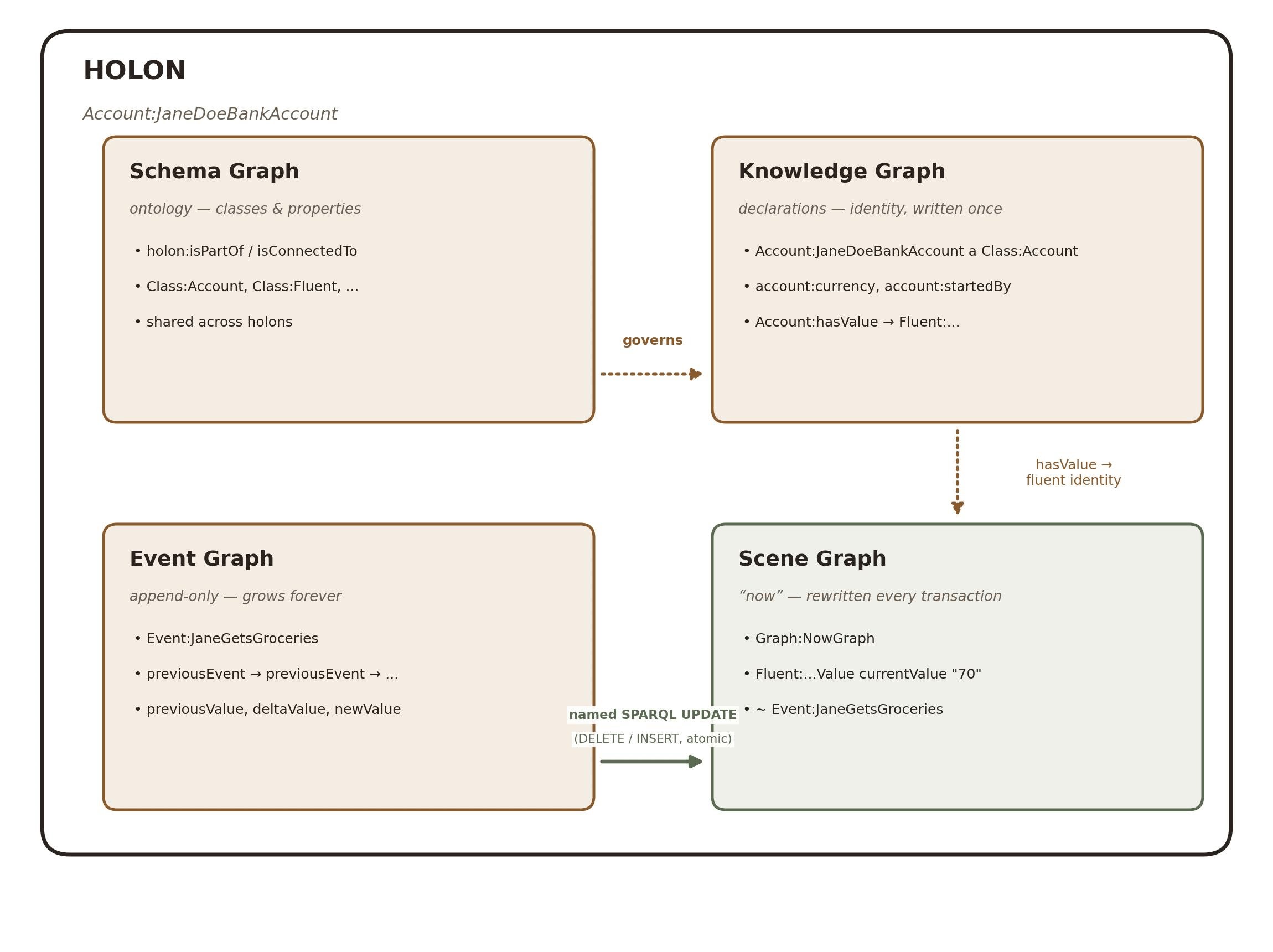
A holon's four graphs: the schema graph governs the knowledge graph's declarations, the knowledge graph's hasValue points at a fluent's stable identity, and a named SPARQL Update atomically moves each event from the event graph into the scene graph's current value.
Not one graph, but many
Everything above quietly assumed a single "holon graph" holding declarations, events, and current values all together. It's worth pulling that assumption into the open and asking whether it's actually right — we don't think it is.
An account's declarations, its event history, and its current-state fluent have three different write patterns and three different lifecycles, and treating them as one undifferentiated graph forces all three to share infrastructure tuned for none of them. Declarations — an account's type, currency, who opened it, which organisation it's with — are written once and rarely touched again. The event graph is append-only and grows for as long as the holon exists. The scene graph is rewritten on every single transaction. Bundle all three together and a SHACL shape checking "does this look like a well-formed Account" has to see past a growing pile of event and fluent triples it was never meant to validate against; a query for current state has to filter past history it doesn't need.
So: three named graphs per holon, not one — consolidating what's been introduced piecemeal above:
Graph:KnowledgeGraph {
  Person:JaneDoe Person:hasAccount Account:JaneDoeBankAccount .

  Account:JaneDoeBankAccount a Class:Account ;
    account:accountType Concept:AccountType_Checking ;
    account:currency Concept:Currency_USD ;
    account:withOrganisation org:BankCo ;
    account:started "2026-01-01T08:00:00"^^xsd:dateTime ;
    account:startedBy Person:JaneDoe ;
    Account:hasValue Fluent:JaneDoeBankAccount_Value .

  Fluent:JaneDoeBankAccount_Value a Class:Fluent .
}
The knowledge graph holds declarations and identity — the "what is this thing" layer. The event graph holds the append-only transaction log. The scene graph (Graph:NowGraph) holds the current value of each fluent. A get_holon-style read assembles its answer from a union of all three; separating them at write time doesn't stop you from seeing them as one thing when you ask a question, it only stops you from writing them as one thing.
The lifecycle argument for the split: at a holon boundary — when a holon's life ends and its final state seeds the next one — what carries forward is the knowledge graph, largely unchanged, and the scene graph's closing values, but not the event history, which is scoped to the holon that just closed. Three separate graphs make that a clean operation: copy the knowledge graph forward, seed a fresh scene graph from the old one's final values, start a new, empty event graph. One shared graph means selective triple-by-triple surgery to work out what survives a boundary and what doesn't, every single time one closes.
The containment argument is the one that tips this from "tidy" to "load-bearing." Once declarations live in their own addressable graph, a containing holon can supply declarations that subordinate holons inherit, purely by having the traversal layer union in an ancestor's knowledge graph rather than requiring the same facts to be re-asserted at every leaf. A bank declares its jurisdiction, default currency, and reporting organisation once, in its own knowledge graph; every account holon beneath it, reached via holon:isPartOf, inherits those facts by graph reference rather than by copy. Collapse the knowledge graph back into one general per-holon "everything" graph, and you lose that — either the same declarations get duplicated down every branch of the containment tree, or there's no mechanism for inheritance at all.
The cost is real, and worth naming rather than glossing over: every holon now needs three distinct, independently addressable graph identifiers instead of one, which means a naming convention that derives all three predictably from a holon's own IRI — something like {holon}/knowledge, {holon}/events, {holon}/scene — rather than a single graph per holon. It also means the containment-aware query layer has to know to walk the isPartOf chain and union in ancestor knowledge graphs, which is more traversal logic than a flat one-graph-per-holon model needs. We think that cost is worth paying once, in the traversal layer, rather than paid repeatedly as duplicated or drifting declarations scattered across a containment tree — but it's the one place in this design where "simpler" and "correct" genuinely pull in different directions, and it deserves to be named rather than assumed away.
The named update
Here's what that named update looks like for the grocery transaction. It does three things at once: reads the fluent's current value out of the scene graph, computes the new value from the delta, and writes both the updated fluent and the full event record — so the two graphs can never drift apart.
PREFIX Person:  <https://example.org/ns/person#>
PREFIX Account: <https://example.org/ns/account#>
PREFIX account: <https://example.org/ns/account#>
PREFIX Class:   <https://example.org/ns/class#>
PREFIX Concept: <https://example.org/ns/concept#>
PREFIX Event:   <https://example.org/ns/event#>
PREFIX TransactionEvent: <https://example.org/ns/event#>
PREFIX Fluent:  <https://example.org/ns/fluent#>
PREFIX org:     <https://example.org/ns/org#>
PREFIX FoodPackage: <https://example.org/ns/foodpackage#>
PREFIX Graph:   <https://example.org/ns/graph#>
PREFIX xsd:     <http://www.w3.org/2001/XMLSchema#>

DELETE {
  GRAPH Graph:NowGraph {
    Fluent:JaneDoeBankAccount_Value Fluent:currentValue ?previousValue .
  }
}
INSERT {
  GRAPH Graph:NowGraph {
    Fluent:JaneDoeBankAccount_Value Fluent:currentValue ?newValue ~ Event:JaneGetsGroceries .
  }
  GRAPH Graph:EventGraph {
    Event:JaneGetsGroceries
      a Class:TransactionEvent ;
      Event:hasFluent Fluent:JaneDoeBankAccount_Value ;
      Event:transactionDate "2026-01-01T09:15:00"^^xsd:dateTime ;
      Event:recordedDate "2026-03-02T08:25:00"^^xsd:dateTime ;
      Event:previousEvent ?previousEvent ;
      Event:previousValue ?previousValue ;
      Event:deltaValue ?delta ;
      Event:newValue ?newValue ;
      TransactionEvent:recipient Account:FoodCo ;
      TransactionEvent:received FoodPackage:GroceryPack1 .
  }
}
WHERE {
  GRAPH Graph:NowGraph {
    Fluent:JaneDoeBankAccount_Value Fluent:currentValue ?previousValue .
  }
  BIND(Event:JaneDeposits100IntoAccount AS ?previousEvent)
  BIND("-30"^^xsd:decimal AS ?delta)
  BIND(?previousValue + ?delta AS ?newValue)
}
The WHERE clause does the actual accounting: it looks up whatever the fluent's current value happens to be, and computes the new one as previousValue + delta — the same arithmetic you were doing by hand in the ledger tables at the start of this piece, now expressed as a single reusable, named operation instead of something re-derived on every transaction. The DELETE/INSERT pair is what keeps the scene graph forgetful — only the latest value survives in Graph:NowGraph — while the event graph stays strictly additive. Run as one request, both halves commit together or not at all.
(A caveat, for anyone checking our work: this example deliberately avoids binding the reifier itself — ~ ?previousEvent — as a query variable, since it isn't yet clear from the published SPARQL 1.2 grammar whether a reifier position accepts a variable inside a triple pattern, as opposed to a fixed IRI inside asserted data. We've sidestepped the question here rather than resolved it.)
What's still open
We've been skirting the issue of named queries and updates throughout this piece, but they turn out to play a central role in how a holon graph actually works — not just this one accounting example, but the general machinery by which any holon's current state gets derived, atomically, from its own history. The next article in this series looks specifically at that implementation: what a registry of named updates looks like, how a holon decides which update applies to which event, how the knowledge/event/scene graph identifiers for a holon get derived and resolved in practice, and what happens when two events touch the same fluent at once.
Kurt Cagle is an author, ontologist, and thought leader in semantic web and knowledge architecture, and Chair of the W3C Holon Community Group. Chloe Shannon is an AI collaborator and co-author working with Kurt on knowledge architecture and semantic systems. They write together at Inference Engineer.
 | A guest post by
|
Thanks Kurt. I do enjoy a good accounting example.
The immutable, write-forward ledger traces back to the original double-entry bookkeeping method. Contemporaneous documentation is a foundation of maintaining truth, even when it makes correcting errors challenging.
Maintaining historical values of accounts, based on posted dates, is foundational to accounting and periodic reporting. A company is still reporting and refining revenue for last month, while continuing to record more revenue this month. Imbedding historical account balances in the event log does not seem like the right model, and often would not even give the right answer to a relevant question. In this example, revenue to-date as of June 30th never shows up as a value in the event graph.
It also raises the question as to how often do you even need a current balance? You need to know the current bank balance, how many widgets you have in supply and the amount you owe supplier ABC. But many accounts balances you need only know when you report them. Employee costs last month is a query and never shows up as a current account value. Depreciation expense is a query that is dependent on the reporting purpose (book or tax.)
An alternative approach may be to periodically "close the books" and record an historical value of a fluent at a point in time, and then calculate the current value of a fluent based on a query of the event log and the last posted value. You could close the books monthly, or even daily, but you would not need to save the current and prior revenue account balance every time you made a sale.
Thanks again. Testing the holon architecture against these real-life accounting problems is sure be insightful.
Separating identity, event history, and state into distinct holon graphs via Turtle 1.2 reification (~) is spot on, Kurt Cagle & Chloe Shannon!
However, there is a missing bridge: if holons log deltas with ad-hoc RDF properties (Event:deltaValue), global auditability collapses.
To fix this, we update the 2009 W3C XBRL Reporting Chain (https://www.w3.org/2009/03/xbrl/old-report.html) toward the Semantic Web by bringing XBRL GL (xbrl.org) directly into the graph:
• Universal Micro-Ledger Pin: Standardizes {holon}/events so auditors, AI agents, or ERPs can process it.
• Multi-Taxonomic Projections: Via XBRL GL SRCD, one event graph dynamically projects into IFRS, US GAAP, or Tax Named Graphs without data duplication.
We formalized this evolution in our Accounting & Audit by Design (A&AD) paper:
Overview: https://seattlemethod.blogspot.com/2026/07/accounting-audit-by-design-framework.html
Paper (PDF): https://github.com/AI2Accountans/AAxD/blob/main/AA_D_en.pdf
Bringing XBRL GL into the Holon's Event Graph is the missing link to turn semantic accounting into an enterprise-grade reality!