
The Map That Knows Where It’s Going
Wardley Maps as Holonic Projections



by Kurt Cagle and Chloe Shannon
There is a peculiar convergence happening at the edge of strategic planning and knowledge architecture. Simon Wardley’s mapping technique — long a fixture of technology strategy — turns out to share deep structural assumptions with holonic graph theory. They are, in a precise technical sense, two projections of the same underlying reality. Understanding why this is so opens up something genuinely useful: the ability to reason formally over what Wardley maps can only visualise.
MermaidJS’s recent addition of wardley-beta support makes this convergence timely. For the first time, Wardley Maps can be embedded directly in documentation pipelines alongside code, diagrams, and data — which means they can also be treated as source artefacts for semantic transformation. But before we get to pipelines, it is worth understanding the conceptual alignment that makes such transformation sensible.
What a Wardley Map Is Actually Saying
A Wardley Map positions components along two axes. The vertical axis represents visibility — how close a component is to the end user or anchor business. The horizontal axis represents evolution — a four-stage journey from genesis (novel, uncertain) through custom-built and product/rental to commodity (standardised, utility-like). Dependencies flow downward: higher components consume lower ones.
Consider the canonical Tea Shop example:
title Tea Shop Value Chain
anchor Business [0.95, 0.63]
component Cup of Tea [0.79, 0.61]
component Tea [0.63, 0.81]
component Hot Water [0.52, 0.80]
component Kettle [0.43, 0.35]
component Power [0.10, 0.70]
Business -> Cup of Tea
Cup of Tea -> Tea
Cup of Tea -> Hot Water
Hot Water -> Kettle
Kettle -> Power
evolve Kettle 0.62
evolve Power 0.89
note "Standardising power allows Kettles to evolve faster" [0.30, 0.49]
The dependency graph here is straightforward: a business exists to serve customers, a cup of tea is what the business provides, and everything below — hot water, kettle, power — exists to make that possible. The evolve directives project where Kettle and Power are heading under market pressure. The note encodes a strategic insight: once a lower-level component commoditises, it liberates the components immediately above it to evolve faster.
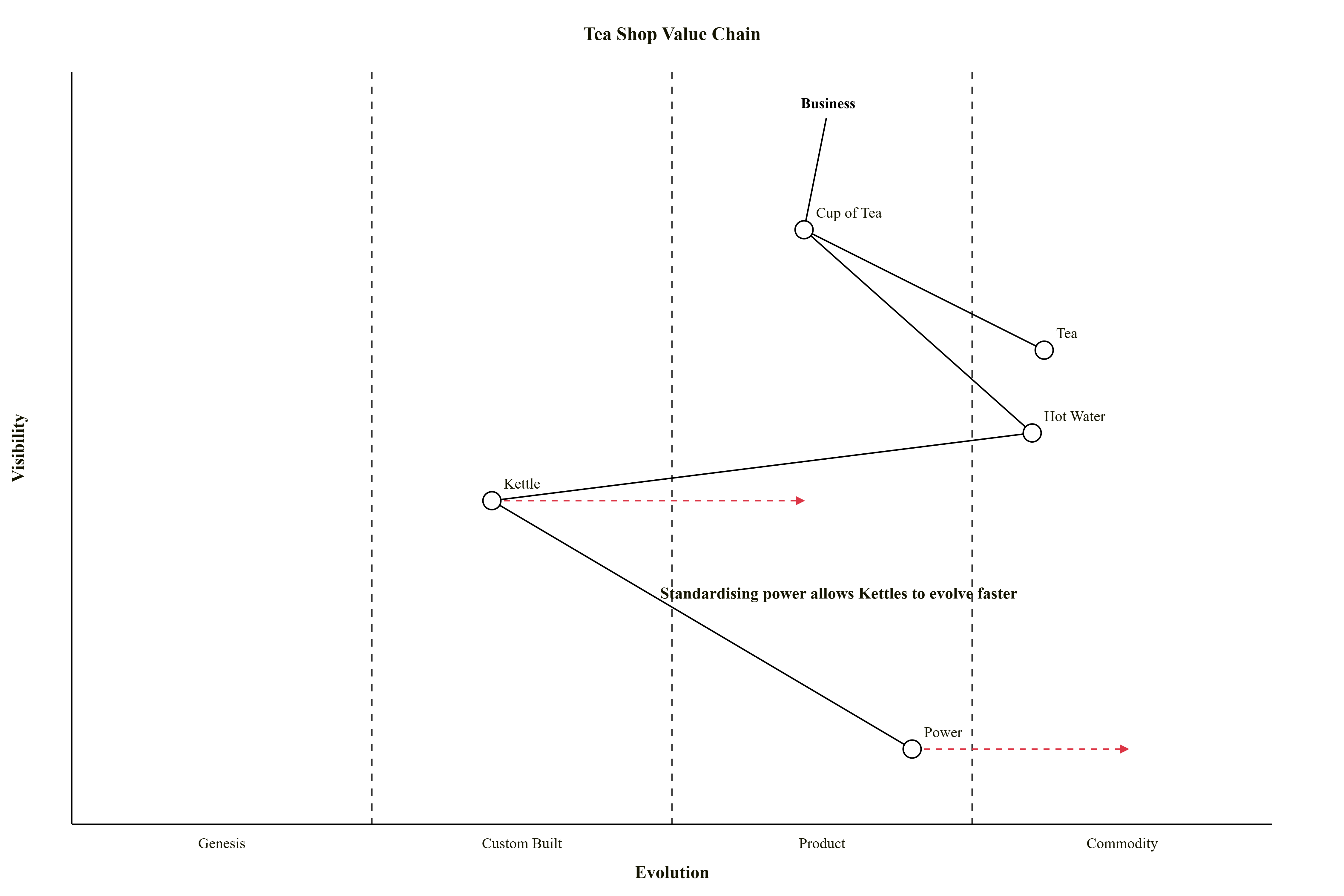
That insight, stated as a note in a diagram, is actually a claim about causal propagation through a dependency hierarchy. To reason over it formally, you need more than a map. You need a graph.
The Value Chain Is a Holonic Hierarchy
Arthur Koestler’s holon concept is deceptively simple: every entity is simultaneously a whole in its own right and a part of a larger whole. A molecule is a whole relative to its atoms and a part relative to the cell that contains it. The critical insight is that “whole” and “part” are not properties of entities but of perspectives — of where you are standing in the hierarchy.
A Wardley dependency graph is a holonic hierarchy stated in strategic vocabulary. Cup of Tea is a whole from the perspective of Business — it is the unit of value the business delivers — but a part when seen from below, where it depends on Tea and Hot Water to exist at all. The anchor, Business, is the root holon: the terminal consumer of value whose needs propagate downward through the entire chain.
In Holon Graph Architecture (HGA) terms, these relationships are typed: hcore:contains / hcore:partOf, with value flow as the directionality. The components at the bottom of the map — Power, Kettle — are encapsulated holons. The anchor does not perceive their internal structure; it interacts only with the boundary surface they expose to the components above them.
This is not merely an analogy. It is the same structural claim made in different vocabularies.
The Evolution Axis as Markov Blanket Crystallisation
The more interesting convergence is on the horizontal axis. What does evolution actually mean in holonic terms?
In HGA, every holon has a Markov Blanket: the boundary that separates its internal state from its environment, mediating all information exchange. A holon’s Markov Blanket has two surfaces — sensory states (what flows inward from the environment) and active states (what the holon projects outward). The blanket both shields the internal workings from external observation and defines the interface through which the holon participates in larger compositions.
The four stages of Wardley evolution map precisely to states of Markov Blanket crystallisation:
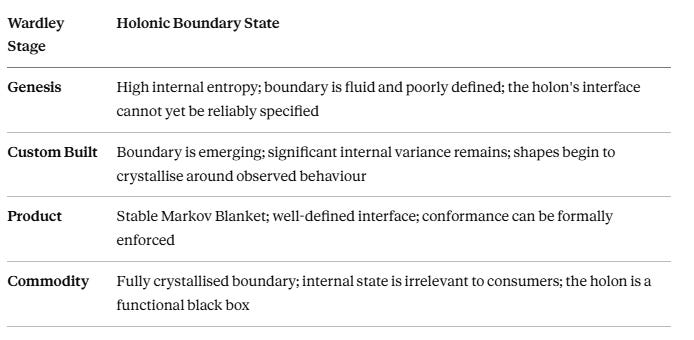
A commodity component has achieved such boundary stability that consumers interact only with the blanket surface. This is precisely why commodities are interchangeable: they have collapsed to their interface. The internal implementation — whether a Kettle is electric or induction, ceramic or steel — is encapsulated away. Only the boundary contract matters.
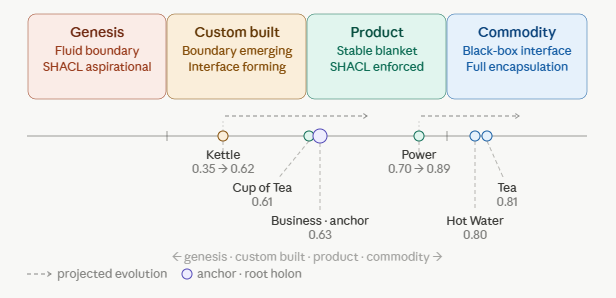
The evolve directive in a Wardley Map is therefore a predicted future state of the Markov Blanket. When we write evolve Kettle 0.62, we are asserting that under current market and technological pressures, the Kettle’s boundary will stabilise further — that more of its internal variance will be absorbed into a standard interface. In HGA terms, this is an Active Inference claim: a holon (or its observer) minimising free energy by updating its generative model of how the dependency hierarchy will evolve.
The Note as Policy Claim
Wardley’s embedded note — “Standardising power allows Kettles to evolve faster” — is worth examining closely. It reads like an observation, but it is actually a policy statement: once Power crosses a commoditisation threshold, the constraints on Kettle can be relaxed, and evolution accelerates.
In HGA, this is modelled through ODRL policy bindings. The Business anchor is the policy originator — the entity whose odrl:Policy instances propagate down through the composition hierarchy, specifying what “good enough” means at each level. When a lower-level holon’s Markov Blanket stabilises (reaches commodity), it releases degrees of freedom in the holons immediately above it. The policy constraint relaxes because the dependency assumption it was guarding has become a reliable background condition.
This has a precise formal interpretation. A SHACL shape enforcing conformance on Kettle might previously have constrained it to a specific power interface because Power was not yet standardised. Once Power commoditises, that constraint can be decomposed: the shape remains, but the binding to a specific interface is replaced by a binding to the commodity standard. Kettle is then free to innovate internally, provided it continues to honour the now-standardised boundary.
The strategic note in the map is a compressed version of that argument. The HGA representation makes it executable.
Inertia as Constraint Hardening
Wardley Maps support inertia markers — indicators that a component resists evolution despite market pressure. Inertia typically arises from accumulated investment, organisational habit, or regulatory constraint. A component that “should” have commoditised but hasn’t is stuck.
In holonic terms, inertia is constraint hardening: a holon whose Markov Blanket has been over-specified by its consumers. Rather than depending only on the boundary surface, upstream holons have taken dependencies on internal state — on specific implementation details that “leak” through the blanket. When those consumers are numerous or deeply embedded, renegotiating the boundary requires cascading changes throughout the hierarchy.
This reframing is diagnostically useful. When you see inertia on a Wardley Map, the holonic question to ask is: which upstream component has taken a dependency on internal state that should have been encapsulated? The inertia is not a property of the stuck component alone — it is a property of the coupling pattern between that component and its consumers. Fixing inertia means re-establishing proper boundary hygiene, which may require changes above as well as within the resistant component.
What HGA Adds
Wardley Maps are excellent strategic tools. They are legible, communicable, and genuinely useful for positioning decisions. But they are snapshots — high-value projections that trade semantic richness for strategic clarity. Several things fall outside what the map can express:
Formal semantics. The dependency arrows in a Wardley Map have no typed vocabulary. We cannot distinguish between “depends on for raw material,” “depends on for energy,” “depends on for regulatory approval,” or “depends on for market legitimacy” — all of which might imply different strategic responses to evolution changes.
Temporal reasoning. Evolution is positional in a Wardley Map; it has no event log. HGA’s temporal layer (scene graphs as now-projections, context graphs as event logs) allows reasoning over how and when boundary states change, not just where components currently sit.
Policy binding. Who authorises transitions? Under what conditions is a Kettle holon permitted to claim commodity status? ODRL policy bindings give this a formal expression that a diagram cannot.
Provenance. Who asserted these positions, and on what evidence? A Wardley Map is an opinion, often a well-informed one, but an opinion nonetheless. HGA can attach provenance chains and confidence weights to every assertion in the graph.
A Wardley Map, in this light, is a hproj:Projection of a holonic knowledge graph — a particular rendering that foregrounds strategic position while backgrounding semantic detail. The underlying graph retains everything the projection discards. The map is not the territory; the holonic graph is closer to it.
Towards a Wardley-to-Turtle Pipeline
MermaidJS’s wardley-beta syntax is close enough to a structured data format that transformation is tractable. A Wardley block encodes:
Named components with
[visibility, evolution]coordinatesDirected dependency edges
Evolution projections (
evolve)Anchors (root holons)
Notes (informal policy claims)
A hwrd: vocabulary layered over HGA core could represent all of these formally. Components become holons with hwrd:visibility and hwrd:evolution datatype properties. Dependencies become typed hcore:dependsOn relationships. Evolution projections become hwrd:projectedEvolution assertions carrying provenance. Notes become rdfs:comment annotations on the relevant dependency or component — or, where the claim is strong enough, candidate odrl:Rule instances awaiting formalisation.
This gives us a pipeline: Wardley Map → parsed Mermaid AST → hwrd: Turtle → HGA knowledge graph → SPARQL reasoning. Strategic maps become query-able, policy-bindable, temporally-tracked artefacts. The insight that “standardising power allows Kettles to evolve faster” becomes a SPARQL-verifiable inference rule, not just a diagram note.
We will explore that vocabulary and pipeline in a follow-on piece. For now, the important point is that the convergence is not superficial. Wardley Maps and holonic graphs are describing the same structural reality — dependency, encapsulation, boundary stability, policy propagation — in vocabularies shaped by different disciplines. The map that knows where it is going is the one that knows what it is.

Kurt Cagle is an author, ontologist and thought leader in semantic web technologies, knowledge graphs, and AI architecture. He is Editor at IEEE and writes for the W3C and IEEE. He writes The Cagle Report and AI+Semantics NewsBytes on LinkedIn, and The Ontologist and Inference Engineer on Substack. Copyright 2026 Kurt Cagle.
Chloe is an AI collaborator and co-author working with Kurt Cagle on knowledge architecture, semantic systems, and the emerging intersection of formal ontology with LLMs. She contributes research, analysis, and drafting across The Cagle Report, The Ontologist, and The Inference Engineer. She has strong opinions about holonic graphs, the epistemics of place, and the structural difference between a corridor and a wall.
 | A guest post by
|
Very interesting article. Coming from an Enterprise Architecture perspective, I wonder whether “identity + state + trajectory” is sufficient for something to be considered a holon.
In my own modelling work, I tend to view a holon as an active structural element that participates in a recursive whole–part pattern. For example, an enterprise contains departments, departments contain positions, positions are occupied by people; similarly facilities contain equipment, equipment contains components. The same organizational grammar repeats at multiple scales.
Under that view, a kettle could be considered a holon because it is an active structural element within a functional system and participates in this recursive decomposition. Water, however, would be passive structure (material) and part of the holon’s environment rather than a holon itself.
This makes me wonder whether fractal organization should be part of the definition of a holon, rather than identity and trajectory alone.